
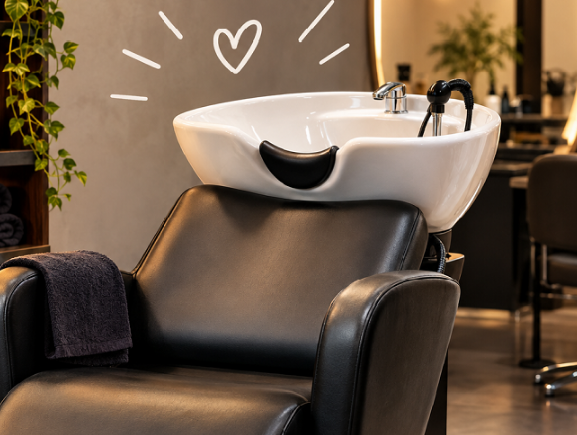
There is a moment in almost every salon appointment that receives far less attention than the haircut itself. It happens at the shampoo basin, when the noise of the salon seems to soften and the appointment briefly becomes about something as simple as water, cleansing and care. It can be easy to think of this part as preparation for the real service. In fact, the shampoo chair can be one of the places where professional hairdressing begins to show its difference.
Washing hair sounds straightforward until you consider how much can influence the result. The amount of product already present, the condition of the lengths, the needs of the scalp, the texture of the hair and what is going to happen next all matter. A professional approach is rarely about applying the same shampoo in the same way to everyone. The cleansing stage can be considered part of the wider service, preparing the hair for cutting, colouring or styling while keeping its condition in mind.
There is also something wonderfully tactile about professional hair washing. Water changes the behaviour of hair immediately. It reveals weight, movement and texture in ways that are less obvious when the hair is dry. As the hair becomes wet, the stylist can begin to understand how it responds. The relationship between moisture, cleansing and conditioning becomes part of the process long before a pair of scissors or a styling brush enters the picture.
This is where products become particularly interesting. Shampoo and conditioner are often discussed as basic household essentials, but professional hair care treats them as tools with specific purposes. A cleansing formula can be selected according to what the hair needs rather than simply according to fragrance or packaging. A conditioner can be used to improve manageability, softness or the feel of the lengths without necessarily weighing everything down. The objective is not to use more. It is to use the right care in the right way.
The same principle continues when the hair leaves the basin. Hair that has been properly prepared behaves differently from hair that has simply been washed. It may respond more predictably to a brush, hold a shape differently or feel easier to work with. That does not mean the shampoo alone creates the finished style. Rather, it forms part of the foundation on which everything else is built.
A professional hairdresser can also notice things during this stage that might otherwise go unnoticed. The way the hair feels between the fingers can reveal changes in condition. The way water moves through the lengths can tell part of the story. The amount of cleansing required may vary depending on what has been used on the hair beforehand. None of these observations needs to become dramatic or complicated. They are simply pieces of information that help guide the service.
The shampoo chair also changes the rhythm of a salon appointment. Hairdressing can involve concentration, conversation, movement and technical work. At the basin, there is usually a different pace. The client is able to sit back while the hairdresser works through a process that requires care rather than speed. The experience can feel almost restorative, but its value is not purely about relaxation. It is an opportunity for the hair to be prepared properly.
That preparation becomes especially relevant when styling is involved. A beautiful blow-dry is not only about the brush and dryer. The condition and cleanliness of the hair underneath influence how the final shape behaves. Too much residue can affect movement, while hair that needs additional conditioning may require a different approach. Professional styling products then have a clearer role because they are being applied to hair that has already been considered rather than simply coated with another layer.
Modern hair care has also become much more nuanced. Current editorial coverage increasingly treats products as part of a more considered routine rather than a collection of miracle solutions, with stylists often discussing the products they keep in their professional kits according to what they help them achieve. That perspective makes sense in the salon environment, where every product has to justify its place through performance.
There is an important difference between product abundance and product expertise. A bathroom shelf can contain dozens of bottles and still leave someone unsure what their hair actually needs. A professional salon may use a much smaller number of products but understand exactly why each one has been chosen. The difference is knowledge. When a hairdresser understands the relationship between cleansing, conditioning, styling and the finished shape, products become part of a coherent process rather than isolated purchases.
This is also why a good salon experience can change the way someone thinks about hair care at home. A professional may introduce a different way of washing, explain why conditioner should be concentrated on certain areas, or demonstrate how much styling product is actually necessary. Small adjustments can make familiar products work more effectively. The goal is not to create dependence on the salon, but to make everyday care more informed.
There is something almost architectural about the process. Cleansing creates the foundation. Conditioning influences the feel and manageability. Cutting gives the hair its shape. Styling brings movement and character to that shape. Each stage contributes to the next. When the sequence works well, the finished result feels effortless because nothing is fighting against what came before it.
Perhaps that is why the shampoo chair deserves more credit than it receives. It is not merely a pause before the haircut. It is where hair is prepared, observed and cared for. It is where professional products become practical tools rather than abstract promises. It is also one of the simplest reminders that good hairdressing is rarely about a single dramatic moment.
The best hair salons in Central London and elsewhere are built around countless details like these. A client’s attention may naturally go to the cut, the colour or the final styling, but the quality of the experience is often created much earlier. Hair that has been properly prepared gives the rest of the service a better starting point.
There is a quiet satisfaction in recognising that. The shampoo chair does not need to be spectacular. Its importance comes from what happens there: careful cleansing, considered conditioning, skilled hands and an understanding of what the hair needs next. It is a small part of the salon experience, but a meaningful one. And sometimes the most important parts of hairdressing are the ones that happen before the final look comes into view.